

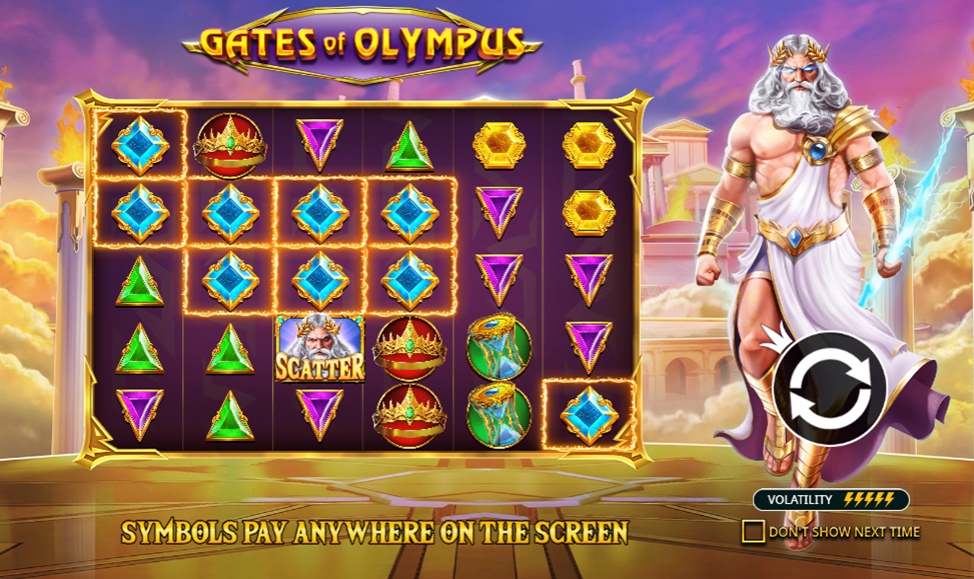
We treat slot paylines as a functional design question rather than a decorative detail. In Spain, players assessing games in the regulated market will see fixed-line slots, ways-to-win games and pay-anywhere titles side by side, and the distinctions affect cost, hit frequency and how wins are interpreted. echa un vistazo is a valuable case study because it is a single Pragmatic Play game with a 6×5 grid and no traditional paylines, yet it still asks players to grasp symbol matching, tumbles and multipliers. We will explore how paylines work, why this title substitutes them with pay-anywhere wins, and what Spanish players should verify before playing.
Variance, RTP and The Spanish Players Should Check
Gates of Olympus is known for remarkably high volatility, which means we ought to prepare for lengthy gaps amid substantial wins and a strong reliance on bonus features. The base RTP is typically shown at 96.5%, but RTP can differ by version or market, so we verify the game information screen as opposed to assuming one figure applies everywhere. In Spain, players in the regulated market should seek the RTP and volatility information within the game, not on a third-party review alone. A elevated RTP does not remove variance; it explains long-term return, not the probable result of a quick session.
We measure volatility with bet size because the two dictate how far a bankroll can survive a dry run. A €0.20 spin on a highly high-volatility game is not the equivalent as a €0.20 spin on a low-volatility 10-line slot, although the stake looks identical. Gates of Olympus offers a bet range that usually starts at €0.20 and can rise to €100, so the minimum is accessible but the swings can nonetheless be intense. We suggest setting a session budget in euros before spinning and treating the maximum win of 5,000x as an result, not a target.
We also verify whether the game version in front of us matches the advertised RTP, because some releases provide lower-return configurations. This is not a reason to distrust the game, but it is a reason to review the information panel before allocating a budget. Spanish players should also observe that volatility influences feature frequency: a game can have a solid RTP and still provide most of its return through free spins and multipliers. If we seek steady small wins, a high-volatility pay-anywhere title is generally the wrong tool; if we accept dry spells for a shot at larger multipliers, it fits that brief.
Tumble System and Sequential Reactions
Cascade mechanics are operative in the base game and free rounds, and they are vital to comprehending the pace. When a win pays out, the winning symbols disappear, residual symbols fall, and fresh symbols fill the grid. If the new arrangement creates another win, the process repeats. This may turn one spin into a chain of winnings, but it might also cease instantly after the first win. We treat tumbles as a independent layer from paylines: they do not establish line paths, they prolong the effects of a pay-anywhere match.
We should also note what the game does not employ. Gates of Olympus does not depend on a traditional wild symbol to substitute along paylines; the Zeus symbol is the scatter that triggers the bonus, and multiplier orbs are separate prize enhancers. That means we cannot interpret it like a traditional five-reel game with wild substitutions and line wins. Rather, we monitor symbol counts, scatter totals and multiplier values. For Spanish players switching from traditional slots, this is the biggest adjustment: the bonus triggers and prize boosts are apparent, but they do not follow line logic.
We evaluate tumbles by analyzing the sequence rather than the initial payout. A individual winning cluster can fade and leave a grid that creates another match, and that following match can be more valuable than the first. Nevertheless, the mechanism does not ensure a chain; many spins conclude after one elimination. We consequently assess the game on the rate of multi-step tumbles, not on the potential alone. This is comparable to how we judge paylines: the existence of many lines does not ensure frequent wins, and the existence of tumbles does not ensure long sequences.
Why Paylines Still Matter in Modern Slot Design
A payline represents a defined path across the reels that needs to display matching symbols in the right order, typically from left to right. When we assess slots, we consider active lines because each line represents a distinct chance to win and a distinct slice of the total bet. A 20-line game with a €1 stake does not put €1 on every line; it distributes the stake across active lines, which affects the value of each line win. This is why two games with the same stake can seem very different: line count, symbol values and hit frequency all influence the experience.
Paylines still matter because they give us a baseline for reading volatility and cost. A slot with many active lines can produce frequent small returns, while a game with fewer lines and larger symbol prizes may fluctuate harder. In Spain, players often transition between traditional line-based slots and newer pay-anywhere releases, so recognising whether a win requires a line or simply a cluster of symbols eliminates confusion. We also apply line count to judge whether a bet range is efficient: a low minimum bet on a 243-ways game is not directly comparable to the same minimum on a 10-line slot.
The payline concept also helps us assess game information screens. Before spinning, we check whether lines are fixed or adjustable, how many lines are active at the chosen stake, and whether the paytable shows line wins or total-bet wins. Some games display prizes as multiples of the line bet, while others display multiples of the total bet; mixing those conventions results in false expectations. Gates of Olympus does not use paylines, but the same discipline holds: we need to know what counts as a win, how the stake is allocated and which symbols trigger features. That habit is more useful than learning a single line pattern.
Understanding the Columns, Lines and Icon Amounts
The 6×5 layout offers Gates of Olympus a vertical play area, and we interpret it by tracking symbols rather than using paths. The paytable groups symbols into lower-value and higher-value tiers, with character symbols generally valued more than objects. Exact prize values can change by version, so we always open the in-game paytable instead of depending on screenshots. What counts for payline comparison is the threshold: eight matching symbols anywhere is the starting point, and the payout rises as the count grows. That is a very different question from querying how many lines a spin triggers.
We use a short checklist to examine the grid before betting, because the visual theme can mislead from the rules that change outcomes. First, we count the grid: six reels and five rows represent 30 positions, so a symbol can appear many times without making a line. todas las opciones Second, we verify the minimum win: eight matching symbols anywhere is the base rule, not three or five on a line. Third, we locate the scatter and multiplier symbols, since they govern feature access and prize enhancement. Finally, we establish the paytable version, because prize values and RTP can vary between releases.
- Count the grid: six reels and five rows mean 30 positions, so a symbol can appear many times without making a line.
- Find the lowest win: eight matching symbols anywhere is the basic rule in Gates of Olympus, not three or five on a line.
- Spot the scatter: the Zeus symbol triggers free spins, and it is not a line-based wild.
- Keep an eye on multiplier orbs: they can show up with values from x2 upward and impact the current win or the free-spins total, according to the phase.
We study the paytable in tiers because the jump between eight, nine, ten, eleven and twelve or more matches is not linear in every game. In Gates of Olympus, the base threshold is eight, and each additional matching symbol transfers us into a higher payout bracket for that symbol. We check whether the paytable lists separate prizes for each count or combines the top end, since that influences how we evaluate a screen with many low symbols. This tiered reading is more precise than asking whether a spin looked busy, and it allows us measure the game with line-based slots that pay only for three, four or five on a line.
Symbol values are not the sole factor; the number of matching symbols is just as important. A high-value character symbol may deliver a substantial multiple at eight matches, while a low-value symbol needs more matches to produce a comparable return. We therefore refrain from assessing a spin by the apparent quality of the symbols only. In a payline game, a row of three high symbols on an active line can be valuable; in Gates of Olympus, the same three symbols are irrelevant unless the total count reaches eight. That difference is central to interpreting the game accurately.
How Gates of Olympus Swaps Paylines with Scatter-Pay Wins
Gates of Olympus features a 6×5 grid, which provides 30 symbol positions, and it does not pay along fixed lines. In contrast, wins are formed when eight or more matching symbols appear anywhere on the grid, without regard to adjacency or a left-to-right path. This is often characterized as a pay-anywhere or scatter-pay model, and it changes the reading of the screen: we look for symbol counts rather than tracing lines. The approach can seem more open than a 20-line slot, but it is not automatically easier, because the minimum matching count and symbol values control how often wins actually land.
The pay-anywhere rule is significant because it takes away the line-bet calculation that many Spanish players are familiar with. There is no need to pick 1, 10 or 20 lines, and no line bet to multiply; the total stake is simply the amount wagered per spin. Wins are paid according to the paytable for the number of matching symbols, with eight as the base threshold and larger counts paying more. This renders the game easier to set up but harder to estimate by eye, since a scattered group of low-value symbols can pay while a visually neat line of three symbols pays nothing.
We should not treat pay-anywhere as a marketing upgrade over paylines; it is a different probability model. Gates of Olympus also features tumbles, so winning symbols are taken away and new symbols fall into place, allowing multiple wins from one spin. That cascading structure is separate from the pay-anywhere rule, but the two work together to create longer win sequences. When we review the game, we distinguish the matching rule from the tumble mechanic, because confusing the two hinders to judge why a spin paid and whether the volatility fits our budget.
Free Spins and Multiplier Build-up
The bonus system is where the game sets itself apart from a simple payline slot. Four or more Zeus scatter icons trigger the bonus round, with extra scatters granting more spins; the precise breakdown is shown in the payout table. During free spins, multiplier orbs can be gathered into a ongoing sum, which then affects wins for the remainder of the round. That accumulation is the primary reason the game can deliver large returns, and it is also why the round can conclude without fanfare if the multiplier values do not build.

We treat the bonus round as a separate volatility event rather than as a certain comeback from a unproductive base game. The number of starting spins, the chance of retriggers and the behaviour of multiplier orbs all determine the feature’s range of outcomes. In our review, we check whether multipliers continue for the entire bonus or reset after each win, because that detail affects how much importance we assign to a long sequence. We also mention that the Zeus scatter symbol is not a line-based wild; it is the bonus trigger, so counting scatters is more useful than tracking paylines.

We also distinguish the triggering condition from the multiplier behavior when we analyze the round. Four scatter symbols start the round, but the value of the bonus hinges on how many spheres show up and whether their values add up into a meaningful total. A feature with several small multipliers can still yield less than a quick base game session, so we steer clear of assuming that bonus spins necessarily justify a larger bet. We record the beginning spin total, any re-trigger and the ultimate multiplier amount, because those details tell us more about the session than the visual display alone.
Stake Range, Session Strategy and Maximum Win Expectations
The wager range is one of the key practical aspects for Spanish players because it determines whether a session can be structured sensibly. Gates of Olympus typically allows stakes from €0.20 to €100 per spin, which covers low-budget play and higher-roller preferences. We must remember that the maximum win is set at 5,000x the stake, so a €0.20 spin has a markedly different theoretical ceiling from a €100 spin. That cap is not a promise; it is the maximum limit of the game’s payout structure, and reaching it hinges on rare multiplier sequences.
We structure sessions around volatility rather than around the maximum win. A sensible approach is to break the session budget into small units, such as 100 spins at the chosen stake, and quit if the budget is used up. Because Gates of Olympus is extremely high volatility, a run of 100 spins can produce little or nothing, especially if free spins do not trigger. We steer clear of increasing the stake to chase losses, and we treat multiplier orbs as random enhancements rather than as a indication that a big win is due. That attitude is more useful than trying to predict tumbles.
We also contrast the bet range with payline alternatives. A 20-line slot at €0.20 may assign one cent per line, while Gates of Olympus applies the full €0.20 to a pay-anywhere spin with tumbles. The two bets are not equivalent in expected outcome or variance. Spanish players should review the minimum stake, the maximum win cap and the RTP version before picking a game for a session. If the ceiling and volatility fit the budget, the game can be assessed on its own terms rather than as a replacement for a line-based slot.